Programación en Python 1 y 2
- Level High School
- Contact Hours 120
- Timeframe Year
Programación en Python 1 y 2 introduce a los alumnos en los fundamentos de la programación informática, haciendo hincapié en ayudarles a desarrollar el pensamiento lógico y la capacidad para resolver problemas. Los alumnos comienzan aprendiendo a diseñar, codificar y probar sus programas mientras aplican conceptos matemáticos. A continuación, pasan a conceptos de programación más avanzados y aprenden a crear programas más potentes utilizando funciones, cadenas, estructuras de datos y operaciones de E/S de archivos.
To view the entire syllabus, click here or click to explore the full course.
MODULES - 16
Los alumnos comprenden de qué trata el curso y reflexionan sobre lo que esperan aprender.
Los alumnos aprenden los fundamentos de la programación dando a Karel las órdenes del Perro en un mundo cuadriculado.
Los alumnos aprenden los fundamentos de la programación escribiendo programas que interactúan con los usuarios a través del teclado.
Los alumnos escriben un programa que permite a los usuarios crear sus propias historias de Mad Lib utilizando variables y entradas del usuario.
Los alumnos enseñan a sus programas a tomar decisiones basándose en la información que recibe.
Los alumnos escriben un programa que cuestiona a los usuarios sobre una serie de preguntas de opción múltiple y comprueba sus respuestas.
Los alumnos aprenden a escribir código más eficaz utilizando bucles como atajos.
Los alumnos escriben un programa para proporcionar información sobre si la contraseña introducida es correcta o incorrecta.
Los alumnos aprenden cómo sus programas pueden descomponerse en piezas más pequeñas que funcionan juntas para resolver un problema.
Los alumnos aprenden estrategias más sofisticadas para manipular texto en sus programas.
Los alumnos programan un juego clásico para dos jugadores que se juega con un dado de 6 caras.
Los alumnos aprenden cómo se forman las tuplas y las listas y los distintos métodos que pueden alterarlas.
Los alumnos aprenden a construir programas más complejos que utilizan cuadrículas y diccionarios.
Los alumnos escriben un programa para un juego de adivinar palabras.
Los alumnos aprenden a leer, escribir y procesar información de archivos de texto.
Los alumnos aprenden las funciones y responsabilidades clave de los miembros de un equipo de desarrollo de software.
Explore programs that your students will build throughout this course!
Here are a few examples of teacher resources and materials to use in the Programación en Python 1 y 2 course
| Standards Framework | Alignment |
|---|---|
| PCEP-30-02 Exam | 100% View |
| Certiport IT Specialist Python | 100% View |
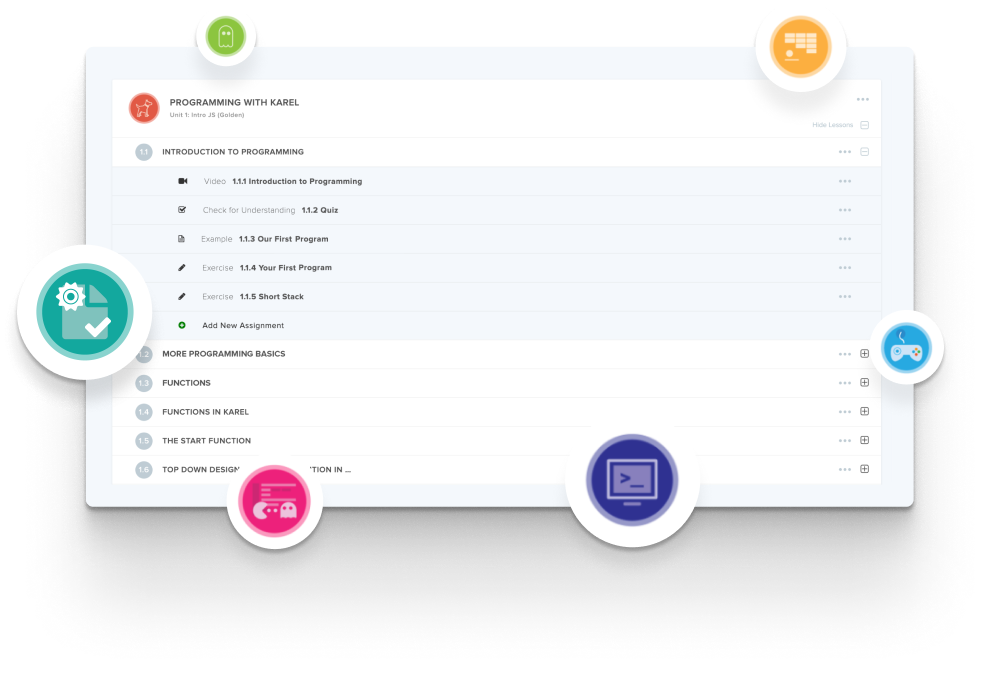
Create and organize Assignments in any CodeHS course that you're teaching. You can even add custom assignments to pre-existing CodeHS courses.
Learn MoreDidn't find what you were looking for? Here are a few links that might be useful to you.
You also might like
Which python course should I use? Click here
Yes. CodeHS designed Introduction to Python Programming as a first computer science course, and it starts from zero with no prior coding experience needed. Students begin with visual Karel the Dog puzzles to build programming logic like loops and conditions, then move into writing real Python. It's a strong fit for high school students taking their first CS class.
No. Introduction to Python Programming assumes no prior coding experience. It opens with Karel the Dog, a visual grid world where students practice sequencing, loops, and conditions before writing Python syntax. Basic math is plenty: the CodeHS course reinforces mathematical concepts as students code rather than requiring advanced math, so true beginners can start with confidence.
Students build a series of interactive Python programs in Introduction to Python Programming, including a Mad Libs story generator, a multiple-choice Quiz Game, a Password Authenticator, the two-player dice game Pig, and a Guess the Word game. Along the way they work with functions, strings, lists, dictionaries, and reading and writing files.
Python is a great first language because its clean, readable syntax lets beginners focus on problem-solving instead of fussing with punctuation. Introduction to Python Programming teaches Python, one of the most widely used languages in data science, artificial intelligence, and web development, so the foundational skills students build carry directly into later CodeHS courses, college classes, and real jobs.
Both are beginner CodeHS courses that start with Karel the Dog and cover the same core programming concepts, so the main difference is the language. Introduction to Python Programming teaches Python, favored in data science and AI, while Introduction to Computer Science in JavaScript teaches JavaScript, the language behind interactive web pages. Choose the one that matches your program's pathway.
Introduction to Python Programming is a full-year course of about 120 contact hours, and it runs entirely in a web browser with nothing to install, so it works on Chromebooks and any school computer. Schools that prefer semester scheduling can teach it as two 60-hour halves, Introduction to Python Programming 1 and Introduction to Python Programming 2.
Yes. Introduction to Python Programming prepares students for the CodeHS Python Level 1 Certification and is also aligned to the PCEP (Certified Entry-Level Python Programmer) exam and the Certiport IT Specialist Python certification. The course includes dedicated certification practice modules to help students build toward these entry-level Python credentials, though earning any certification still depends on the exam itself.
After Introduction to Python Programming, CodeHS recommends AP Computer Science Principles in Python to pursue college credit, or Data Science with Python to apply coding to real datasets. Both lead toward Applications of AI and Machine Learning. The course anchors the CodeHS Python and Artificial Intelligence pathways for high school.