





Arkansas Introduction to Computer Science
- Level High School
- Contact Hours 145
- Timeframe Year
The Arkansas Introduction to Computer Science course introduces students to foundational computer science topics, encompassing programming concepts, career paths, and computational thinking. Students will explore data analysis, visualization, and emerging technologies in the field of computer science.
To view the entire syllabus, click here or click to explore the full course.
MODULES - 15
Students learn the basics of programming by writing programs that interact with users through the keyboard.
Students teach their programs to make decisions based on the information they receive.
Students learn how to write more efficient code by using loops as shortcuts.
Students learn how to decompose problems into smaller pieces that work together to solve a problem.
Students learn how tuples and lists are formed and the various methods that can alter them.
Students learn to read, write, and process information from text files.
Students will be introduced to the field of data science by exploring the role of a data scientist and the iterative steps of the data science life cycle. They will learn and apply the process, which includes asking statistical questions, collecting or obtaining reliable data, analyzing the data, and summarizing the results.
Students will explore ethical considerations in the field of data science. This module focuses on teaching students about data privacy and how to work with data responsibly.
Students delve into key areas such as personal data collection, the reliability of online information, cyber ethics and laws, personal data security, cybersecurity essentials, and strategies to combat common cyber threats and their prevention, equipping individuals with the knowledge to navigate the digital landscape responsibly and securely.
Students will explore key technologies shaping the digital world. Topics include the evolution of cryptography, the roles of human and artificial intelligence, cloud and edge computing, the impact of the internet, and the foundations of blockchain. Together, these lessons highlight how computing innovations continue to transform society.
In this hands-on module, students will learn how to train AI models and will explore the use cases for AI in various industries.
Students compare and contrast common operating systems (Windows, Linux, OS) and explain the importance of application security. They will investigate security options and implement user accounts to enforce authentication and authorization. Students will also demonstrate how to work with basic and advanced command prompts.
Students explore the structure and design of the internet and networks, and how this design affects the reliability of network communication, the security of data, and personal privacy. Students will learn how the Internet connects computers all over the world by using networking protocols.
Students learn about the physical elements of computers and networking, such as motherboards, RAM, routers, and the use of port numbers, Ethernet, and wireless devices.
Students will prepare for future academic and career opportunities by exploring student organizations, building strong resumes and interview skills, and creating professional portfolios. These lessons help students develop the tools and experiences needed to showcase their strengths and achieve their goals.
Explore programs that your students will build throughout this course!
Here are a few examples of teacher resources and materials to use in the Arkansas Introduction to Computer Science course
| Standards Framework | Alignment |
|---|---|
| Arkansas Introduction to Computer Science | 100% View |
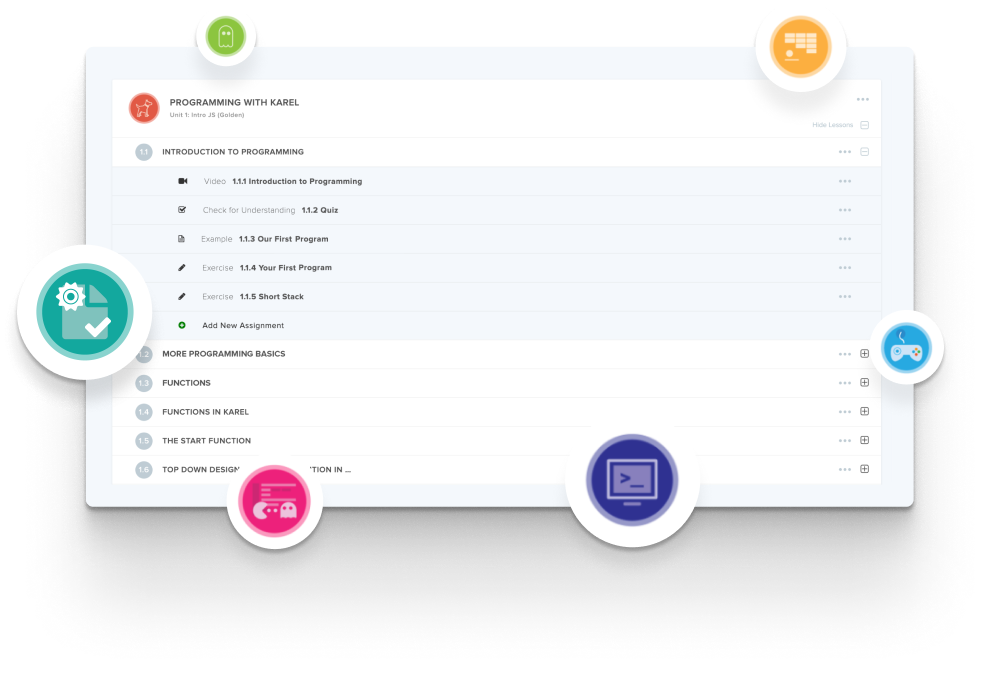
Create and organize Assignments in any CodeHS course that you're teaching. You can even add custom assignments to pre-existing CodeHS courses.
Learn MoreDidn't find what you were looking for? Here are a few links that might be useful to you.
A course 100% aligned to new Arkansas standards introducing foundational CS — programming concepts, career paths, computational thinking, data analysis, visualization, and emerging technologies.
High schoolers; no prerequisites. It's the first course of the new Arkansas CTE pathways and is also available to all students to meet the graduation requirement.
The framework grew from 47 to 60 standards, making it longer and more in-depth; scaffolding/enrichment modules (e.g., Turtle Graphics, Karel in Python) are available in supplemental.