



Science Olympiad Code Craze (HS)
- Level High School
- Contact Hours 85
- Timeframe Year
This course is designed for Science Olympiad (C) high school participants who want to compete in the Code Craze event in the 2026-2027 school year. This course covers the following major topic areas: 1. Principles of Coding 2. AI & Machine Learning 3. Cryptography 4. Python Programming 5. Quantum Computing Event participants will be tested via an interactive quiz and a coding activity.
Activities in this course require student access to third party AI tools including ChatGPT; Gemini; Microsoft Copilot; Google Teachable Machine; Google AI Experiments (Quick, Draw!, etc.); Stable Diffusion (Hugging Face).
To explore the full course, click here.
MODULES - 17
Karel is a dog that only knows how to move, turn left, and place tennis balls in his world. You can give Karel these commands to instruct him to do certain things. We use Karel to show you what it means to program, and allow you to focus on problem-solving.
In this module, students will gain an understanding of the main concepts and vocabulary around AI.
Students will learn the fundamentals of machine learning, covering its lifecycle, supervised, unsupervised, and reinforcement learning, and explore bias within learning models.
In this hands-on module, students will learn how to train AI models using Teachable Machine and will explore the use cases for AI in various industries.
Students will explore the ethical implications and risks of AI technology, including bias, hallucinations, security, disinformation, and legal challenges, ending in a project to create a public service announcement about AI.
Students dive into the history of cryptography systems, the motivation behind using encryption systems, and modern cryptography systems. This includes explaining the core concepts of Public Key Infrastructure and hash functions. Students will also explore the importance of digital certificates, and authentication methods.
Students learn the basics of programming by writing programs that interact with users through the keyboard.
Students teach their programs to make decisions based on the information it receives.
Students learn how to write more efficient code by using loops as shortcuts.
Students learn how their programs can be decomposed into smaller pieces that work together to solve a problem.
Students learn more sophisticated strategies for manipulating text in their programs.
Students learn how tuples and lists are formed and the various methods that can alter them.
Students learn to build more complex programs that make use of grids and dictionaries.
Students learn to use standard and third-party Python libraries to work with web data, perform numerical computing, clean and visualize datasets, and test their own code.
Students explore foundational artificial intelligence concepts, including graph search algorithms, heuristic and greedy search, and core machine learning models such as linear regression, k-nearest neighbors, decision trees, neural networks, and clustering.
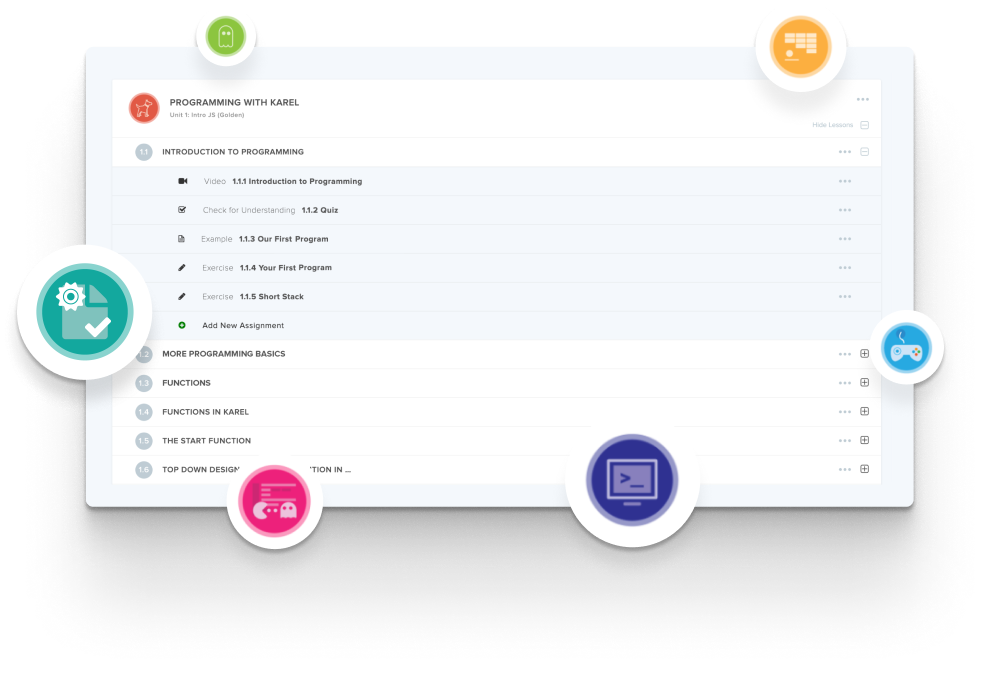
Create and organize Assignments in any CodeHS course that you're teaching. You can even add custom assignments to pre-existing CodeHS courses.
Learn MoreDidn't find what you were looking for? Here are a few links that might be useful to you.
The Science Olympiad Code Craze High School (HS) course is designed to prepare division Code Craze participants for the Science Olympiad Division C invitational, regional, state and national competition events.
Principles of coding, AI and machine learning, cryptography, Python programming, and quantum computing.
Through interactive quizzes and a coding activities, according to the Code Craze event rules. The course material is organized to prepare for both.
Python. The course covers console interaction, conditionals, looping, functions and exceptions, strings, and creating and extending data structures.
Science Olympiad Code Craze (MS) covers Division B and runs about 45 hours against this course's 85. The high school version adds quantum computing and goes further in Python, covering strings and data structures that the middle school version does not.
About 85 contact hours, listed as running across a school year alongside the competition season.